A world does not need to be perfectly realistic. It needs to feel plausible inside its own rules.
I look for the internal logic of a place: what shaped it, what people need to survive there, how architecture responds to climate, how technology belongs to the culture, and what traces people leave behind.
The question is not only: “Is it real?” The better question is: “Does it feel believable?”
The environment should carry narrative before any explanation is given. A road, wall, doorway, bridge, cistern, machine, ruin, cable, footprint, salt stain, or distant light can suggest history and human behavior.
Many of my strongest images are built around arrival: someone enters, crosses, observes, or discovers a world larger than themselves.
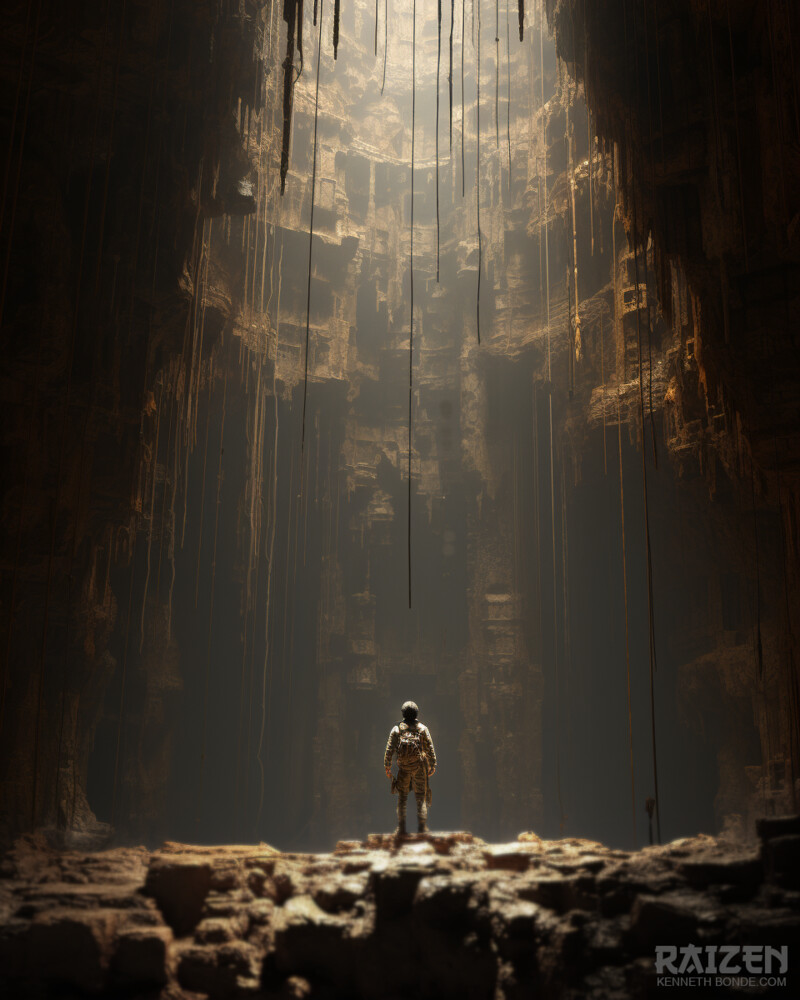
Small figures are not decoration. They create emotional access and help the viewer imagine standing inside the world.
Buildings should not feel pasted onto a landscape. They should feel shaped by geography, materials, climate, belief, and survival.
I prefer images that open a door rather than explain everything. A strong world should answer one question and create two more.
A strong visual idea must survive beyond the first beautiful image.
My production background affects how I think. I naturally look for repeatable rules, visual consistency, clear priorities, reference systems, and design logic that can scale across a sequence, a pitch deck, a film, an animation project, or a game world.
This is where worldbuilding, art direction, and production design meet: the visual language must be emotionally powerful, but also coherent enough to guide future decisions.
AI is part of my creative workflow, but it is not the author. It helps with exploration, iteration, testing, image direction, and visual problem-solving. The value is in artistic judgement: knowing what works, what breaks the world, what should be rejected, and how to refine the result.
Defining the emotional target, visual language, composition, and design constraints before generating images.
Choosing the image that belongs to the world, not simply the image that looks most impressive.
Maintaining consistency of architecture, atmosphere, scale, materials, motifs, and world logic across multiple images.
Using traditional tools, editing, paintover thinking, technical notes, references, and production documents to move from possibility to clarity.
I design complete cinematic worlds that are believable, internally consistent, emotionally engaging, and ready to support a production.
This is the thread connecting my personal projects: Al-Mawrid, Temple Gorge, Journey, The Last Caravan, and Salt & Shadows. Different worlds, different surfaces, same underlying discipline.
VIEW PROJECTSFor project inquiries, visual development, worldbuilding, or AI-assisted production workflows.
EMAIL KENNETH ARTSTATION LINKEDIN